

Non-Compete & Trade Secret Lawyers
Restrictive Covenants and Confidential Information
When departing employees take your clients, your confidential information, or your proprietary processes, we act quickly to seek court orders stopping the misuse and to recover damages under state and federal law.
Serving Alabama, Georgia & South Carolina · Commercial litigation and dispute counsel
Flexible Fee Structures
Contingency · Hourly · Hybrid
Seven Days a Week
Free, confidential consultation
Three States
Alabama, Georgia & South Carolina
Your State's Rules Control Your Dispute
Contract deadlines and forums differ across the three states we serve. South Carolina gives half the time Alabama and Georgia do. Choose the state where your dispute sits for the law that applies to your company.

Alabama
Six years on written contracts, from the breach (Ala. Code § 6-2-34)
Non-Competes & Trade Secrets in Alabama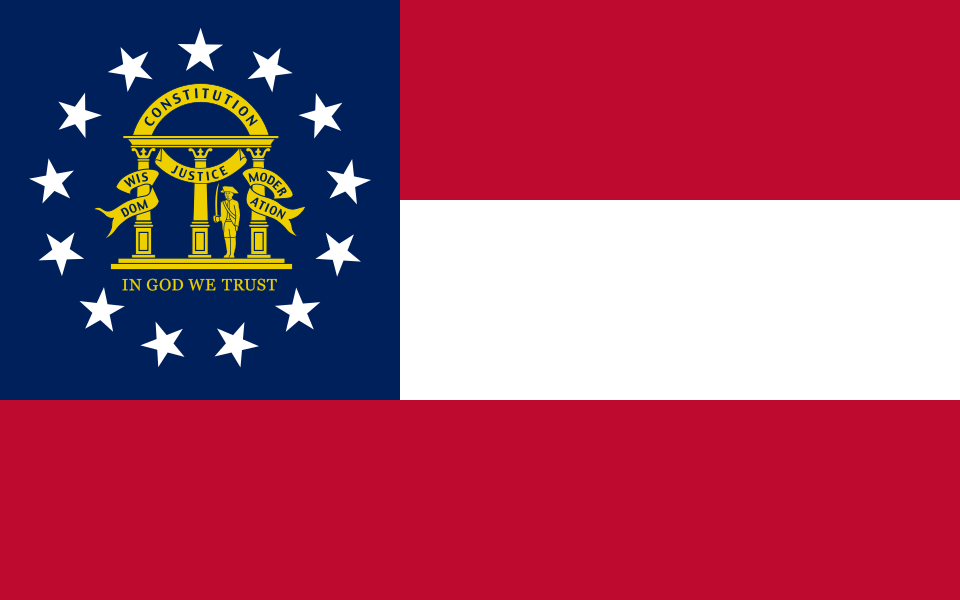
Georgia
Six years on written contracts, from the breach (O.C.G.A. § 9-3-24)
Non-Competes & Trade Secrets in Georgia
South Carolina
Three years on written contracts, from when the breach was or should have been discovered (S.C. Code § 15-3-530)
Non-Competes & Trade Secrets in South CarolinaNon-Compete & Trade Secret Lawyers Serving Alabama, Georgia & South Carolina
A departing employee who takes a client list, proprietary pricing, or confidential methods to a competitor can cause a loss that exceeds the value of any single contract. Alabama's Trade Secrets Act and the federal Defend Trade Secrets Act provide substantial remedies, including injunctive relief, disgorgement of profits, and attorneys' fees. Injunctive relief in particular depends on a prompt application, since delay undercuts the showing of irreparable harm. Our non-compete and trade secret attorneys serve businesses across Alabama, Georgia, and South Carolina.
Non-Competes & Trade Secrets Representation in Alabama, Georgia & South Carolina
A company's competitive position rests on its relationships, its processes, and its proprietary information. When an executive or key employee leaves and takes that information to a competitor, or forms a competing business on the strength of it, the loss begins immediately and is difficult to reverse once customers have moved. We represent businesses across Alabama, Georgia, and South Carolina in expedited trade secret and non-compete litigation, including applications for temporary restraining orders, preliminary injunctions, and expedited discovery, which in these matters are often filed within days. We also handle the broader category of unfair competition claims: diversion of business opportunities, solicitation of customers in breach of a non-solicitation agreement, and misuse of confidential pricing, client, or technical information.
Alabama's industrial services, professional services, and staffing sectors are particularly exposed to trade secret and non-compete issues. Client relationships built over years, proprietary pricing models, and specialized technical processes carry substantial value, and that value transfers with the employee who holds it unless the company has taken steps in advance to prevent it.
Who We Represent
Common Non-Competes & Trade Secrets
What We Pursue for You
Understanding Non-Competes & Trade Secrets in Alabama, Georgia & South Carolina
Overview
Your people, your customer relationships, and your confidential information are among your most valuable assets, and they are also the most portable. When a key employee leaves for a competitor, or walks out with your client list or proprietary processes, the threat to your business is immediate. Understanding how each state protects these assets, and the limits of that protection, is essential.
This guide explains how non-compete agreements and trade-secret protections work under Alabama, Georgia, and South Carolina law. The rules differ sharply at each state line and are unforgiving of poorly drafted agreements, which is why understanding them before a departure, not after, makes all the difference.
Three States, Three Frameworks for Non-Competes
Alabama regulates restrictive covenants by statute, permitting reasonable non-competes in defined circumstances while protecting employees from overbroad restraints. Georgia enforces covenants against qualifying employees under its Restrictive Covenants Act (O.C.G.A. Section 13-8-50 et seq.), and its courts may blue-pencil an overbroad covenant rather than void it. South Carolina is the outlier: non-competes there are governed by common law, disfavored, strictly construed against the employer, and generally not rewritten by the courts. If a key term is overbroad, the covenant can fail entirely.
In every state, enforceability turns on whether the employer has a protectable interest, whether the restriction is reasonable in duration and geographic scope, and, where a statute applies, whether the employee falls within the categories it permits to be restrained. Agreements drafted without close attention to these requirements often fail precisely when an employer needs them most.
Protecting Trade Secrets
Separate from contractual non-competes, the trade secrets acts of all three states, alongside the federal Defend Trade Secrets Act, protect confidential business information, such as customer lists, pricing, formulas, and processes, that derives value from not being generally known and that the business takes reasonable steps to keep secret. Misappropriation of a trade secret can support claims for injunctive relief and damages even without a signed agreement.
The phrase 'reasonable steps to keep secret' is doing a lot of work. A business that labels nothing confidential, gives broad access, and imposes no safeguards may find that information it considered proprietary does not qualify for protection. Trade-secret protection is earned through the precautions you take.
Acting Fast When an Employee Departs
When a key employee leaves under suspicious circumstances, the first days are critical. Evidence of what was taken, downloaded, or solicited is most accessible immediately and degrades quickly. Courts can grant temporary restraining orders and preliminary injunctions to stop ongoing harm, but only on a prompt, well-supported request.
A measured but immediate response (preserving electronic evidence, sending appropriate notices, and evaluating injunctive options) protects both your assets and your ability to obtain relief. Delay signals to a court that the harm may not be as serious as claimed.
Steps to Protect Your Business
Use carefully drafted agreements
Non-competes and non-solicitation clauses must fit your state's requirements on duration, scope, and covered employees to be enforceable.
Take real steps to guard secrets
Confidentiality labels, access controls, and clear policies are what convert sensitive information into legally protectable trade secrets.
Preserve evidence immediately on departure
Secure devices, access logs, and email records the moment a key employee leaves under questionable circumstances.
Evaluate injunctive relief quickly
Where ongoing harm is occurring, a prompt request for a restraining order can stop it. The window for credible action is short.
Common Mistakes to Avoid
Key Terms Explained
Restrictive Covenant
A contractual promise, such as a non-compete or non-solicitation clause, limiting an employee's post-employment activities.
Protectable Interest
A legitimate business interest, such as trade secrets or customer relationships, that justifies enforcing a restrictive covenant.
Trade Secret
Confidential information that derives value from secrecy and is subject to reasonable efforts to keep it secret.
Injunctive Relief
A court order requiring a party to stop certain conduct, often sought urgently to prevent ongoing competitive harm.
Frequently Asked Questions: Non-Competes & Trade Secrets
How quickly can we get an injunction to stop a former employee?
An application for a temporary restraining order can be filed and heard within days. Alabama courts will issue emergency relief on a credible showing of irreparable harm and a likelihood of success on the merits. Both parts of that showing are weakened by delay, because a company that waited to apply has some difficulty arguing the harm could not wait.
Our former employee says their non-compete is unenforceable. Is that true?
Not necessarily. Alabama courts enforce reasonable non-compete agreements under Alabama Code Section 8-1-190. Courts examine the scope, geographic area, and duration. An overly broad agreement may be modified rather than voided outright. Enforceability turns on the particular language and the particular facts, so the agreement has to be read before the question can be answered.
What if the new employer knew the employee was bound by a non-compete?
A new employer who knowingly induces breach of a non-compete, or who uses misappropriated trade secrets, can be liable for tortious interference and trade secret misappropriation, and in some circumstances for punitive damages. Claims against both the former employee and the new employer are available where the facts support them. Knowledge on the new employer's part has to be established, which is a matter of proof rather than assumption.
What counts as a trade secret?
Alabama, Georgia, and South Carolina each have a trade secrets act, and the federal Defend Trade Secrets Act applies alongside them. In general, a trade secret is information that derives economic value from not being generally known and is the subject of reasonable efforts to keep it secret. Client lists, pricing models, proprietary processes, technical specifications, and business strategies can all qualify if you take steps to protect them. We advise businesses on protection practices as well as enforcement.
Free Guides on Non-Competes & Trade Secrets
Related Practice Areas
Contract Disputes
A breached contract produces a measurable loss for the party that performed. We represent businesses across Alabama, Georgia, and South Carolina in breach of contract litigation, demand enforcement, and negotiated resolutions.
Commercial Litigation
Some commercial disputes are resolved in negotiation. Others are tried. We represent businesses across Alabama, Georgia, and South Carolina in commercial litigation from pre-suit demand through verdict and appeal.
Employment Disputes
An employment claim against a business requires a prepared defense. We represent employers across Alabama, Georgia, and South Carolina in discrimination claims, wrongful termination disputes, wage disputes, and non-compete enforcement.